
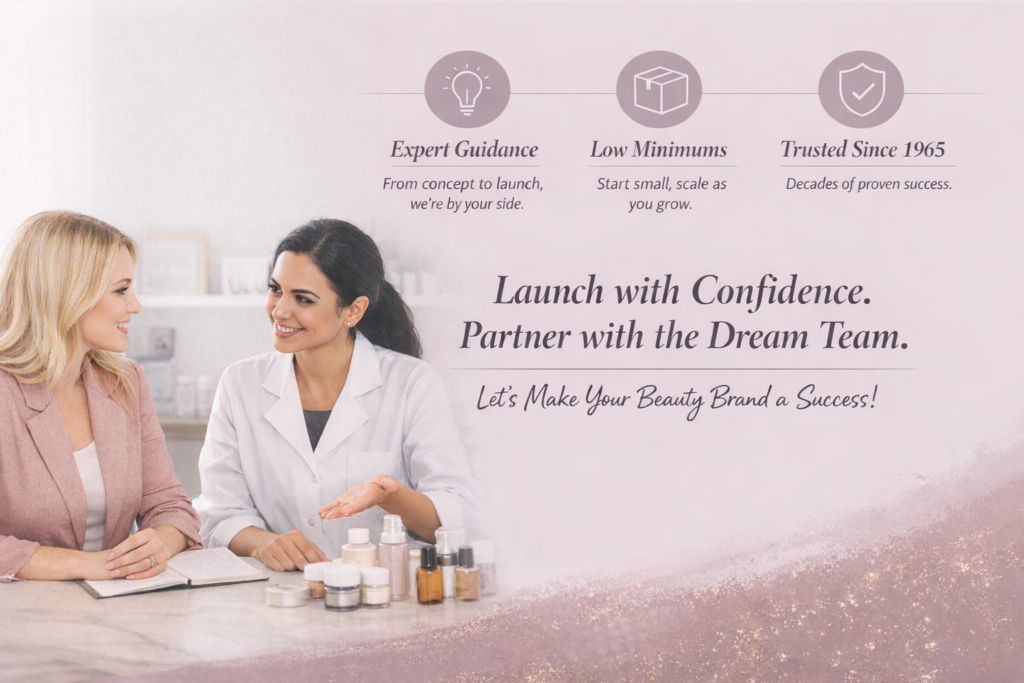

Thinking of starting a cosmetics business in 2026? This 10-step guide from Audrey Morris Cosmetics breaks down real costs, compliance requirements, manufacturing decisions, and the common mistakes brand owners make before launch.
This guide outlines how to start a private label cosmetics in 2026, outlining everything from early planning and brand value to compliance, manufacturing, and inventory decisions. This guide highlights the common mistakes founders make, real startup challenges, and how service-driven manufacturing partnerships can reduce risk. This blog is aimed at aspiring and early-stage brand owners evaluating how to enter the cosmetics market.
How to Start a Cosmetics Brand in 2026: Complete Step-by-Step Guide from Audrey Morris Cosmetics
 Talk to a Private Label Expert
Starting a cosmetics brand is more attractive than ever in 2026.
It’s also more misunderstood than most brand owners realize
From the outside, cosmetics businesses appear to be thriving, and the industry seems profitable. New products are launched overnight. Beautiful packaging fills influencer pages. It’s easy to believe that all you need is a good idea and the rest will fall into place.
What most people don’t see is what happens behind the scenes when founders try to start their own cosmetics company.
The financial decisions that feel irreversible.
The compliance and regulatory details that seem minor until they become urgent.
The moment when excitement becomes pressure, and pressure becomes doubt.
At Audrey Morris Cosmetics, we have worked with beauty founders and brand owners for decades. We’ve helped brands launch smoothly and seen promising ideas crash and burn before they ever reach the market.
The difference between these two scenarios is rarely ever hard work or creativity.
It’s preparation.
It’s guidance.
It’s having the right team of experts by your side before decisions start to compound.
This article outlines the 10 steps you need to take to start a private label cosmetics brand in 2026. This is not a hype piece for people looking to “start a side hustle for fun.” It’s for founders who want to start their own cosmetics line in 2026 and want to do it with confidence, clarity, and fewer risks.
Step 1: Understand what starting a cosmetics brand actually involves
Before you start thinking about formulas, packaging, and marketing, you need to have an honest understanding of what you are getting yourself into.
Starting a cosmetics brand isn’t just about creating beauty products and watching the money pour in. It’s about building a regulated, consumer-facing business in one of the world’s most competitive industries.
At a minimum, you will be responsible for:
- Product safety
- Regulatory compliance
- Manufacturing standards
- Brand credibility
- Customer trust
Many founders in the cosmetics industry underestimate this phase. They are too excited to get started and assume they’ll figure things out as they go. This approach may work in certain industries. In cosmetics, it becomes very expensive very quickly.
Founders who will succeed in 2026 are not the ones who know everything upfront. They are the ones who understand that they need support from an industry partner before they make mistakes that are difficult to unwind.
Step 2: Define your brand before defining your product
A common mistake among entrepreneurs is defining the product before defining their brand. They are excited about ingredients, trends, formulations, and formats. However, when you ask them, “Why should your brand exist?”, they have no clear answer.
To become a successful cosmetics company in 2026, you must build your brand around:
- A clear customer
- A specific problem or gap in the market
- A reason to trust the brand behind the product
Ask yourself:
- Who is this product for?
- Why should they choose my brand over one they already trust?
- What does success look like for them after using my products?
If those answers aren’t clear, take a step back. Otherwise, every product decision becomes guesswork, and guesswork becomes unnecessary revisions, delays, and costly overruns.
This is why working with a dream team is so essential. A good manufacturing partner does not just ask what you want to make. They help you think through what makes sense to make.
Step 3: Research the market with judgment, not just data
Market research is crucial but often misunderstood.
Many entrepreneurs think they need to spend hours analyzing competitors’ websites, pulling trend reports, or discussing what people are buying. All this information is useful, but it is not enough.
What you actually need is judgment.
Trends come and go. Market saturation happens quietly. Products that look popular online don’t always translate to sustainable demand on the ground.
At Audrey Morris Cosmetics, we have seen founders chase trends that were already fading while ignoring opportunities that didn’t look exciting on the surface but performed consistently over time.
Before starting your private label cosmetics brand in 2026, ask yourself:
- Is this category growing, or is it just loud?
- Are customers loyal, or are they constantly switching from one brand to another?
- Do these ingredients require education, or is the demand already established?
- How sensitive is my target market to price, claims, or packaging?
As a brand owner, you don’t need more dashboards or spreadsheets. You need perspective. You need to work with a partner who recognizes patterns and knows when to slow down, pivot, or move forward confidently.
Step 4: Understand the real cost of starting a cosmetics brand
Now that you’ve laid the initial groundwork for understanding your brand and market, you need to get your finances in order.
Many founders budget for the obvious expenses, like formulations, packaging, and marketing. However, they forget to account for:
- Testing and stability studies
- Regulatory reviews and labeling
- Minimum order quantities
- Storage and warehousing
- Revisions and relaunches
These aren’t obvious upfront costs, but they can add up fast.
We have seen founders struggle with expenses because no one helped them prioritize their spending.
This is where working with an established private label cosmetics manufacturer comes in. With private labeling, you don’t have to build everything from scratch. At Audrey Morris Cosmetics, we have infrastructure that works, a dream team of experts, compliant processes, quality control systems, and supplier relationships. This helps you save on private label startup costs and reduce your risk.
Step 5: Navigate FDA compliance before it becomes problematic
FDA compliance is one of the most intimidating aspects of starting a private-label cosmetics company.
Cosmetics do not require FDA pre-approval, which may lead brand owners to assume compliance is straightforward. It’s not.
Between ingredient restrictions, labeling language, proper INCI naming, and claims management, there are many details that can quietly derail your launch.
Most compliance mistakes are subtle. A product that needs relabeling. A claim that unintentionally crossed into drug territory. Documentation that doesn’t exist when needed. These mistakes can become expensive to fix.
Working with an industry expert is crucial to ensure FDA compliance. This is not an area you want to learn through trial and error. Compliance must be handled as part of the process, not as a final checklist.
Step 6: Choosing the right manufacturing path
As a brand owner, you have to decide whether you’ll manufacture independently or work with a private-label cosmetics manufacturer.
Manufacturing in-house gives you full control. However, it also gives you full responsibility. You have to fix every mistake, delay, or quality issue.
Working with the right private label cosmetics company gives you access to:
- Proven formulations
- Established quality control
- Regulatory oversight
- Scalable production
The keyword here is right.
Not all private label companies are created equal. Some focus on volume. Others prefer to churn out products as fast as possible. The best partner focuses on teamwork, guidance, and customer service. At Audrey Morris Cosmetics, we help brand owners make decisions that support long-term success, not just fast launches.
Step 7: Prioritize quality control from day one
After choosing a manufacturing plan, you need to prioritize quality control from the onset. This is not an option. Your reputation is at stake.
Products that separate, leak, spoil, or irritate can follow your brand for a long time.
Unfortunately, most quality issues do not come from bad intentions. They come from skipped testing, rushed timelines, and a lack of understanding of how your formulas interact with your packaging over time.
A strong quality control system should include:
- Stability testing
- Compatibility testing
- Batch consistency checks
- Ongoing monitoring
When quality is built into every step, brand owners can focus on growth instead of damage control.
Step 8: Make smart inventory decisions
You’ve already had your meeting with the private label company and discussed ingredients, products, and formulations. Now you need to decide how many products to make in your first batch.
This decision can feel like gambling at first.
Order too little and you risk selling out just as demand for your product increases. Order too many, and you tie up your money in products that may not move.
You need to think about minimum order quantities, shelf life, storage costs, and cash flow.
Smart inventory strategies allow brand owners to:
- Start with a smaller batch.
- Test demand
- Gather feedback
- Adjust before scaling
Your inventory should support learning, not add pressure to your growing business.
This flexibility is one of the biggest advantages of working with an experienced private label cosmetics company. We understand how a brand’s inventory needs evolve over time.
Step 9: Plan for speed without sacrificing quality
In the cosmetics industry, timing is everything.
Beauty trends wait for no man. However, speed without structure leads to mistakes that slow you down later.
Brand owners who try to manufacture their own products often miss the trends they aim to capture. Speed is not about rushing your products to the market. It’s about not reinventing established processes.
Working with a private-label cosmetics company lets you leverage ready-made formulations, established suppliers, and a streamlined production process to move faster without cutting corners.
Step 10: Manage packaging and supply chain realistically
Packaging is one of the most underestimated challenges in beauty and cosmetics manufacturing.
Bottles, droppers, labels, pumps, and cartons can come from different suppliers or different countries. One delay can stall your entire launch.
Brand owners are often surprised by the many moving parts that sit outside the formula itself.
Managing packaging and supply chain effectively requires:
- Quality checks
- Supplier coordination
- Lead time planning
- Contingency thinking
A private label cosmetics company can handle this for you, leaving you free to focus on building your brand instead of chasing vendors.
What changes when you don’t do this alone
Audrey Morris Cosmetics makes the process of starting your own cosmetics line less chaotic.
Not by selling products first, but by standing with brand owners while they make important business decisions.
When entrepreneurs have the right support:
- They face fewer risks.
- They make clearer decisions.
- Product launches feel steadier.
- They focus on preventing mistakes rather than on damage control.
Having a dream team of chemists and experts behind you as you start your cosmetics line turns uncertainty into confidence and momentum.
Conclusion
Starting a cosmetics brand in 2026 is not easy
However, it does not have to feel overwhelming.
With the right guidance, brand owners can focus on what matters and launch their products confidently. That’s the role Audrey Morris Cosmetics plays behind the scenes.
